The American Driving Test Index: 50 states + DC, ranked.
Getting on the road looks different in every state. We ranked all 50 plus DC on the three things that shape a new driver's experience: how hard the knowledge test is, how safe the roads are, and how much it costs to insure a car. Every number comes from official government and industry data, and it's all free to explore below.
Three views, one map.
Flip between test difficulty (how strict the knowledge test is), road safety (how dangerous the roads are), and insurance burden (how heavy the cost of insuring a car is). In every view, a darker shade means a higher score. Hover, tap, or pick a state to see its details and open its page.
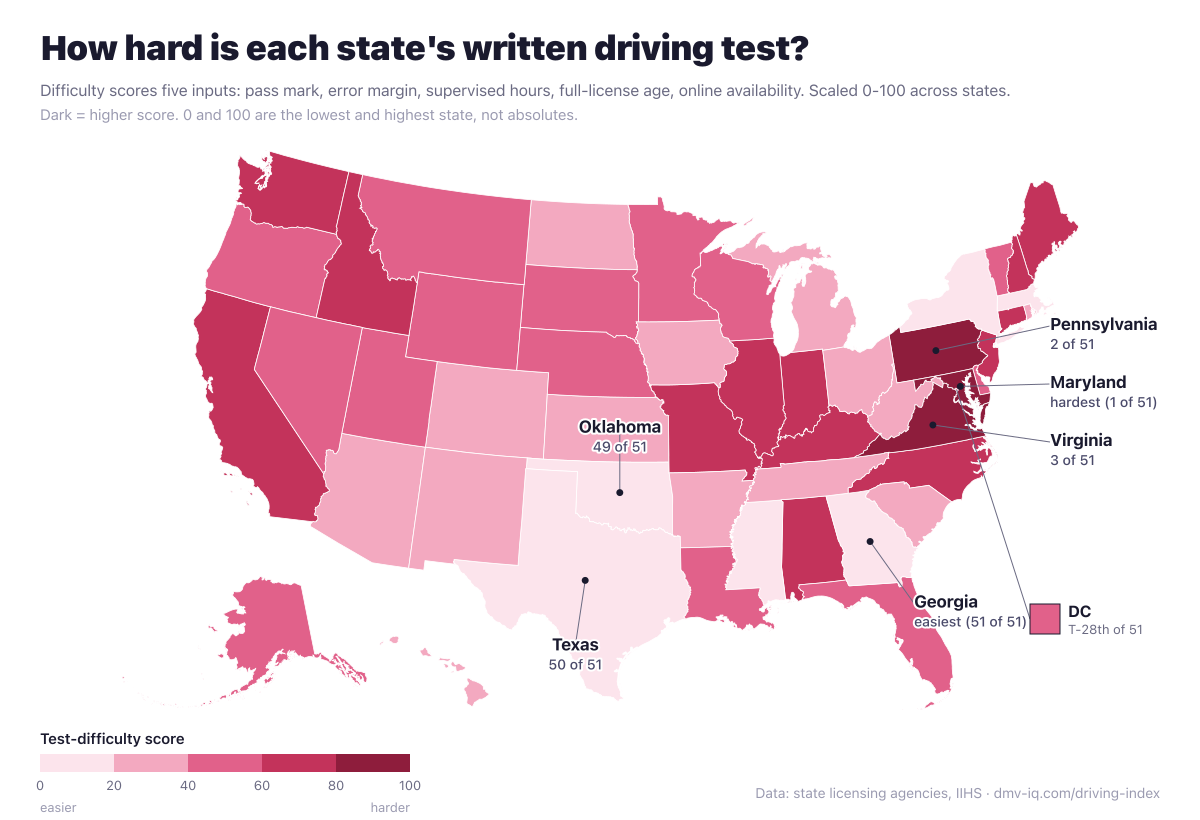
Source: state DMV licensing pages and IIHS state-laws tables (2025).
Pick a state from the menu above or tap one on the map to see its details.
What the numbers say.
Across the 51 jurisdictions we score, harder knowledge tests and safer roads tend to travel together - but loosely. Two findings stood out.
Of the hardest knowledge tests and the safest road networks, only New Jersey, Maryland, Maine and Washington show up on both lists.
New York has one of the country's easier tests (#47) but the 3rd-safest roads. Idaho does the opposite - 5th-hardest test, 45th on safety.
On the other end, 3 states appear in both bottom-10s (easiest tests AND most dangerous roads): Oklahoma, Iowa, Mississippi.
Do harder tests mean safer roads?
Barely. Plot every jurisdiction's test difficulty against its road-safety score and the cloud is nearly round: the correlation is r = 0.20, which explains only about 4% of the difference between states.
r = 0.20 · almost no relationship: test difficulty explains only about 4% of the safety spread. Driving exposure tracks safety far more than licensing rules do. Scores are scaled 0-100 across states, so 0 and 100 mark the lowest and highest state, not absolutes.
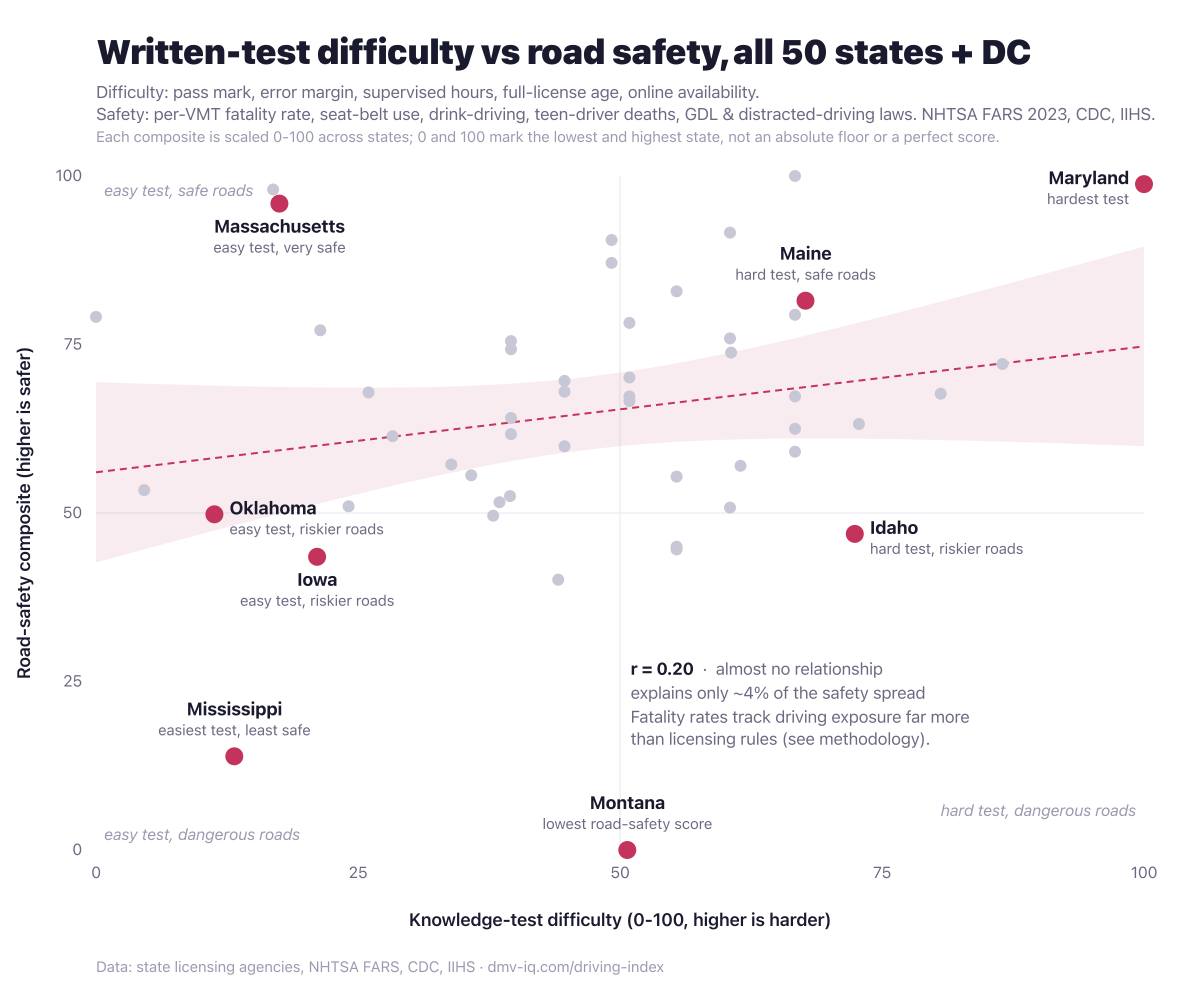
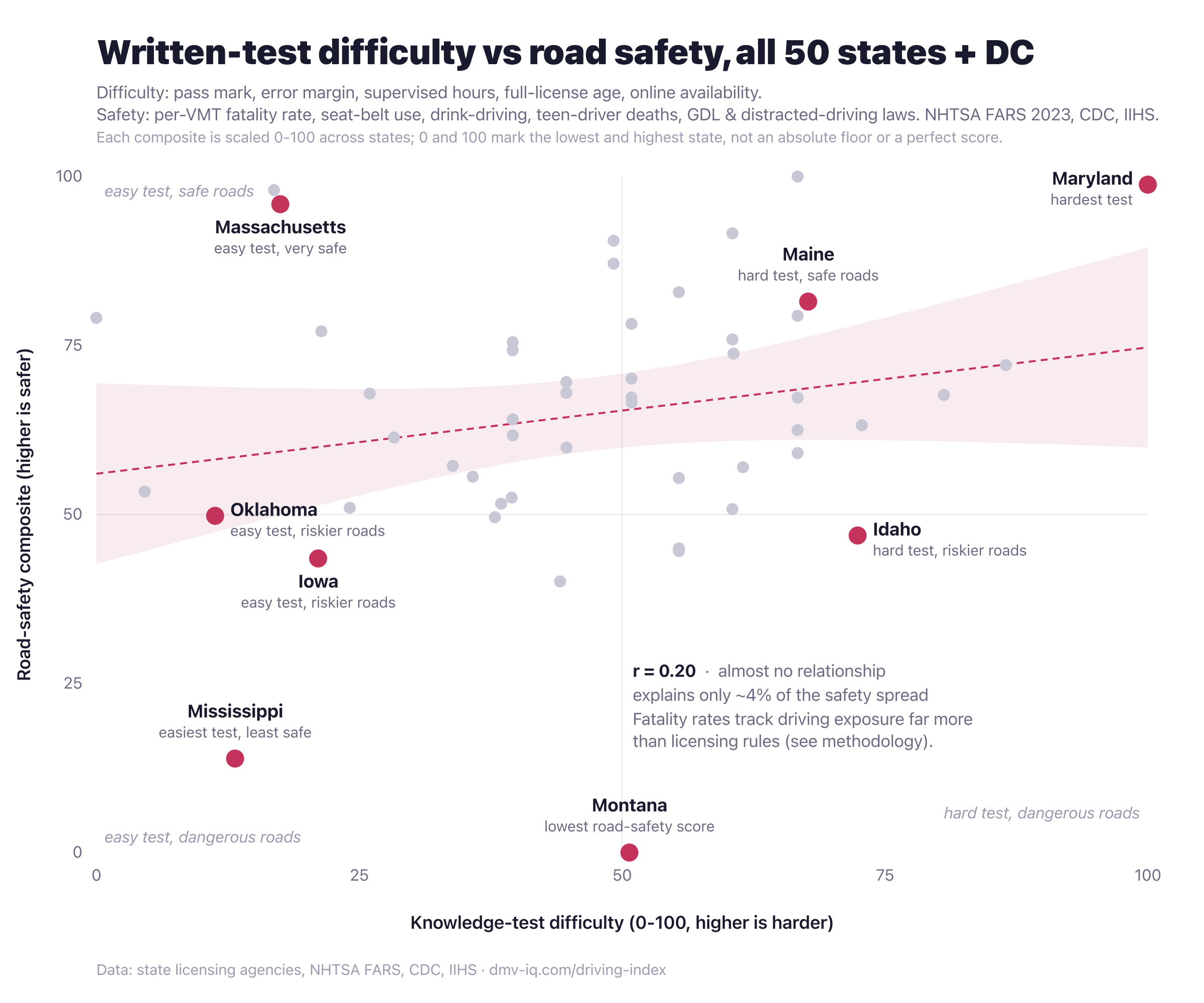
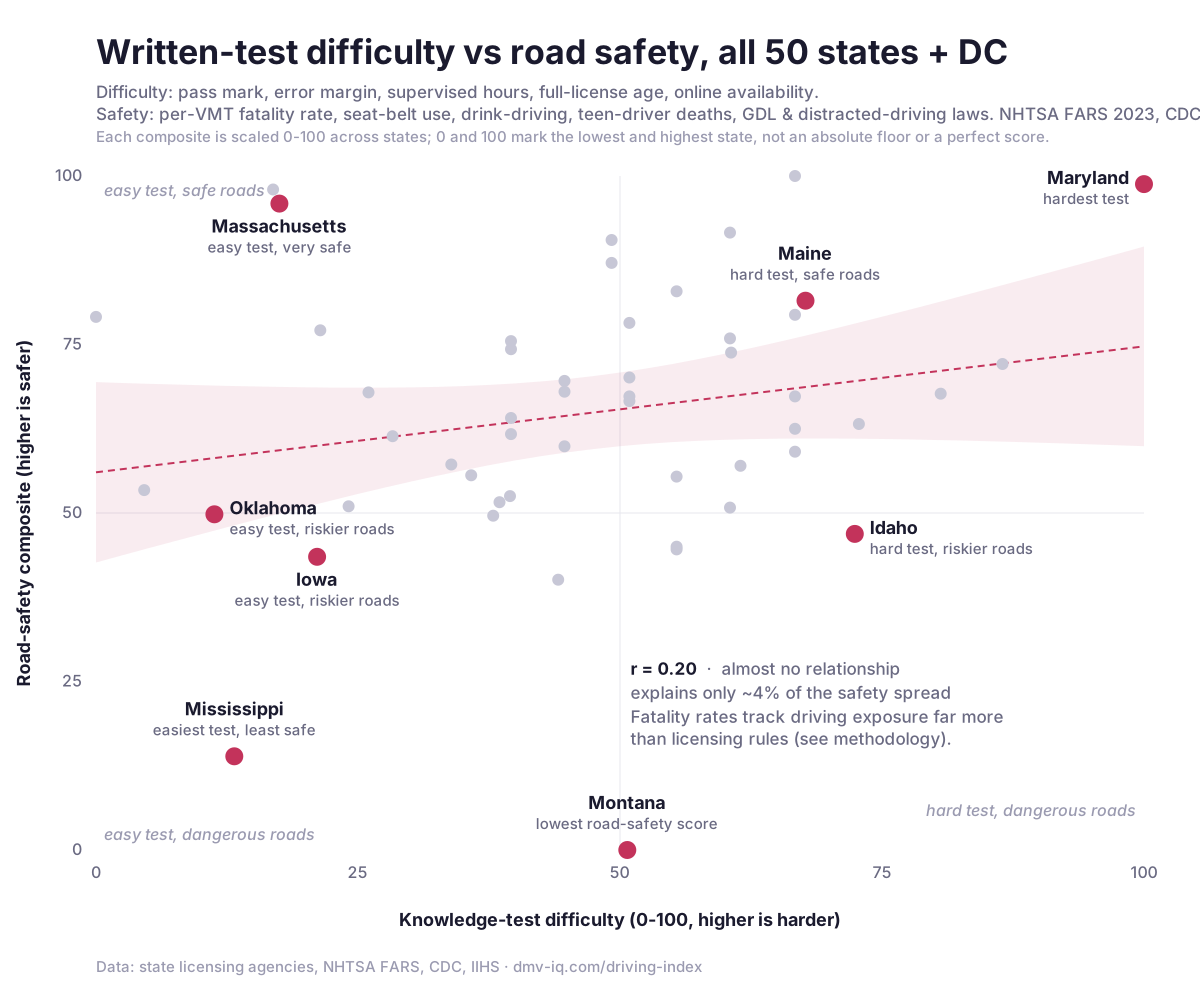
Why test difficulty and road safety barely correlate. The index measures test difficulty because test-takers need to know it, and road safety separately, as context. It has never claimed one causes the other. Between-state fatality differences are dominated by driving exposure and geography, enforcement, and demographics, which licensing rules do not control. A plain exposure measure, vehicle-miles driven per person, correlates with the safety score at r = -0.55 (about 2.7x the strength of the test-difficulty link, and roughly 31% of the variance versus 4%). State licensing rules explain little of the between-state variance in road outcomes. That is context for the map, not a verdict on whether harder tests are worthwhile.
Every state, at a glance.
All 50 states plus DC, side by side. Sort and filter below. Ranks always stay out of all 51.
Showing 1–26 of 51 jurisdictions. Ranks are always out of all 51; “T-” marks a shared rank.
| State | Test difficulty | Road safety | Insurance burden | Pass mark | Supervised hrs |
|---|---|---|---|---|---|
| MarylandSouth | 100.0†1st of 51 | 98.82nd of 51 | 51.412th of 51 | 88% | 60 |
| PennsylvaniaNortheast | 86.52nd of 51 | 72.118th of 51 | 34.626th of 51 | 83% | 65 |
| VirginiaSouth | 80.63rd of 51 | 67.723rd of 51 | 25.3T-34th of 51 | 85% | 45 |
| North CarolinaSouth | 72.84th of 51 | 63.228th of 51 | 15.447th of 51 | 80% | 60 |
| IdahoWest | 72.45th of 51 | 46.945th of 51 | 11.149th of 51 | 85% | 50 |
| MaineNortheast | 67.76th of 51 | 81.59th of 51 | 5.651st of 51 | 80% | 70 |
| New JerseyNortheast | 66.7T-7th of 51 | 100.0†1st of 51 | 51.811th of 51 | 80% | 50 |
| WashingtonWest | 66.7T-7th of 51 | 79.410th of 51 | 38.422nd of 51 | 80% | 50 |
| IllinoisMidwest | 66.7T-7th of 51 | 67.3T-24th of 51 | 35.625th of 51 | 80% | 50 |
| IndianaMidwest | 66.7T-7th of 51 | 62.529th of 51 | 23.438th of 51 | 80% | 50 |
| AlabamaSouth | 66.7T-7th of 51 | 59.133rd of 51 | 37.023rd of 51 | 80% | 50 |
| KentuckySouth | 61.512th of 51 | 57.035th of 51 | 32.228th of 51 | 80% | 60 |
| CaliforniaWest | 60.613th of 51 | 73.817th of 51 | 42.519th of 51 | 83% | 50 |
| ConnecticutNortheast | 60.5T-14th of 51 | 91.65th of 51 | 42.718th of 51 | 80% | 40 |
| New HampshireNortheast | 60.5T-14th of 51 | 75.914th of 51 | 18.5T-42nd of 51 | 80% | 40 |
| MissouriMidwest | 60.5T-14th of 51 | 50.842nd of 51 | 43.917th of 51 | 80% | 40 |
| DelawareSouth | 55.4T-17th of 51 | 82.98th of 51 | 55.58th of 51 | 80% | 50 |
| LouisianaSouth | 55.4T-17th of 51 | 55.437th of 51 | 73.82nd of 51 | 80% | 50 |
| WyomingWest | 55.4T-17th of 51 | 45.046th of 51 | 16.346th of 51 | 80% | 50 |
| NebraskaMidwest | 55.4T-17th of 51 | 44.647th of 51 | 20.640th of 51 | 80% | 50 |
| OregonWest | 50.9T-21st of 51 | 78.212th of 51 | 36.024th of 51 | 80% | 50 |
| NevadaWest | 50.9T-21st of 51 | 70.119th of 51 | 48.814th of 51 | 80% | 50 |
| FloridaSouth | 50.9T-21st of 51 | 67.3T-24th of 51 | 87.01st of 51 | 80% | 50 |
| WisconsinMidwest | 50.9T-21st of 51 | 66.626th of 51 | 24.936th of 51 | 80% | 50 |
| MontanaWest | 50.725th of 51 | 0.0†51st of 51 | 18.641st of 51 | 82% | 50 |
| MinnesotaMidwest | 49.2T-26th of 51 | 90.56th of 51 | 27.633rd of 51 | 80% | 40 |
- MarylandSouth100.0†1st98.82nd51.412th
- PennsylvaniaNortheast86.52nd72.118th34.626th
- VirginiaSouth80.63rd67.723rd25.3T-34th
- North CarolinaSouth72.84th63.228th15.447th
- IdahoWest72.45th46.945th11.149th
- MaineNortheast67.76th81.59th5.651st
- New JerseyNortheast66.7T-7th100.0†1st51.811th
- WashingtonWest66.7T-7th79.410th38.422nd
- IllinoisMidwest66.7T-7th67.3T-24th35.625th
- IndianaMidwest66.7T-7th62.529th23.438th
- AlabamaSouth66.7T-7th59.133rd37.023rd
- KentuckySouth61.512th57.035th32.228th
- CaliforniaWest60.613th73.817th42.519th
- ConnecticutNortheast60.5T-14th91.65th42.718th
- New HampshireNortheast60.5T-14th75.914th18.5T-42nd
- MissouriMidwest60.5T-14th50.842nd43.917th
- DelawareSouth55.4T-17th82.98th55.58th
- LouisianaSouth55.4T-17th55.437th73.82nd
- WyomingWest55.4T-17th45.046th16.346th
- NebraskaMidwest55.4T-17th44.647th20.640th
- OregonWest50.9T-21st78.212th36.024th
- NevadaWest50.9T-21st70.119th48.814th
- FloridaSouth50.9T-21st67.3T-24th87.01st
- WisconsinMidwest50.9T-21st66.626th24.936th
- MontanaWest50.725th0.0†51st18.641st
- MinnesotaMidwest49.2T-26th90.56th27.633rd
Each score is scaled 0 to 100 across all 51 jurisdictions, so 0 and 100 mark the lowest and highest in that column, not an absolute zero or a perfect score. Georgia's 0.0 test-difficulty means it is the least demanding to license in, not that it has no test.
What a license really costs.
Passing the test is the cheap part. The real bill is insurance. In 2023 the average American driver spent $1,282 a year to insure a car, and more than one in seven drivers carried none at all. Where you live moves that number a lot: our Insurance Burden Index, which blends spend, uninsured drivers, affordability and required coverage into one 0-100 score, puts Florida under the heaviest load and Maine the lightest. Flip the map above to Insurance burden to see all 51 shaded, and the table below scores each state.
The fees are tiny. The first year of insurance is not.
The DMV fees to get on the road, the permit and the license, come to under $100 almost everywhere. Then the first insurance bill arrives. Here is the first-year total in the five priciest and three cheapest states, fees and insurance stacked together.
About $1,075 separates Florida ($1,913) from North Dakota ($838). The fees barely move the needle; the premium is the whole story. And because these are all-driver averages, a brand-new driver usually pays two to three times as much in year one.
The road test, state by state.
Passing the written knowledge test earns a permit; the behind-the-wheel road test earns the license, and what it takes varies widely, from 20 to 100 supervised hours, with one state (Mississippi) skipping the road test entirely. Our road-test guides cover the rules, what to bring, how the drive is scored, and retakes for all 51 jurisdictions. These states ask for the most practice:
Know the test. Now pass it.
The index shows how hard each state's written exam is. Our free practice tests get you ready for it, with real questions, instant explanations, and a readiness score that tells you when you're set to pass. Pick your state and start in seconds.
Find your state's free practice test →How we built this.
For road safety, we read NHTSA's fatal-crash records (41,025 of them, the most recent national release), pair them with FHWA's state-by-state vehicle-miles and licensing tables, layer in CDC self-reported behavior for seat-belt use and drinking-and-driving, and finish with the IIHS's state-laws tables for graduated-licensing and distracted-driving provisions. Six pieces of data, equally weighted, scaled 0-100.
For test difficulty, we score five inputs read straight from each state DMV: the passing score, the margin you're allowed for error, supervised-driving hours required before a road test, the age at which the full license arrives, and whether the test can be taken online. Same scaling, same scoreboard. Both composites are min-max scaled 0-100 across states, so 0 and 100 mark the lowest and highest state, not an absolute floor or a perfect score.
For insurance burden, we weight four 2023 inputs: the NAIC average annual expenditure (45%), the IRC uninsured-driver rate (25%, since uninsured drivers shift cost onto everyone else), the average expenditure as a share of the Census median household income (20%, which turns cost into affordability), and the statutory minimum-liability index inverted (10%, because thinner required coverage leaves more exposure). Each input is min-max scaled across the 51 jurisdictions, then combined by those weights into a 0-100 score where higher means a heavier burden.
For the true cost of getting licensed, we add the one-time government fees (the permit fee and the initial driver-license fee, counted once where a state bundles them) to a first-year insurance estimate equal to the NAIC 2023 all-driver average expenditure. That average is deliberately conservative: new drivers commonly pay two to three times it. Driver education is required for most under-18 applicants but is bought from private providers at prices the state does not set, so we describe it rather than fold a made-up number into the total.
A few things we don't claim. The correlation between test difficulty and road safety in this dataset is r = 0.20 - a real, positive nudge, but well short of cause-and-effect. We describe the picture; we don't prescribe. Single-year crash counts in very small jurisdictions are noisy. Self-reported survey data is self-reported. The sources below have the receipts.
Why difficulty and safety barely move together. Fatality differences between states are driven mostly by driving exposure and geography, enforcement, and demographics, none of which a licensing rule controls. A plain exposure measure, vehicle-miles driven per person, correlates with the safety score at r = -0.55 - about 2.7x as strong as test difficulty, and roughly 31% of the between-state variance versus 4%. State licensing rules explain little of the between-state variance in road outcomes; that is not the same as saying a harder test does not help the person taking it.
On the safety ranking's stability. The road-safety composite weights its six inputs equally. Dropping any single input one at a time keeps the ranking almost unchanged (Spearman rho stays at or above 0.94 across all six leave-one-out variants), so no one metric is driving the result.
Sources & data notes
- NHTSA Fatality Analysis Reporting System (FARS) 2023 Annual Report Filelast verified 2026-07-15
- FHWA Highway Statistics 2024, Table VM-2last verified 2026-07-15
- FHWA Highway Statistics 2024, Table DL-22last verified 2026-07-15
- FHWA Highway Statistics 2024, Table DL-1Clast verified 2026-07-15
- FHWA Highway Statistics 2024, Table MV-1last verified 2026-07-15
- CDC Behavioral Risk Factor Surveillance System (BRFSS) Prevalence Datalast verified 2026-07-15
- IIHS — Graduated licensing laws by statelast verified 2026-07-15
- IIHS — Electronic device use laws by statelast verified 2026-07-15
- IIHS — Seat belt laws by statelast verified 2026-07-15
- Composite score: each of the six metrics is converted to a z-score across the 51 jurisdictions; the four 'lower is better' metrics are sign-flipped; the six z-scores are averaged and the result rescaled linearly to 0–100 (higher = safer / stronger laws).
- BRFSS 'Drink and Drive' module is not run by every state every year; states without 2023 data use the most recent prior year (recorded per state in context.metric_years).
- GDL and distracted-driving strength scores are computed by DMV IQ from the IIHS law tables; they are not official IIHS ratings.
- Teen-driver fatality-rate denominator was estimated from the national teen share of licensed drivers for DC, KY, where FHWA DL-22 reported an implausibly small "19 and under" count (context.teen_rate_denominator_estimated = true).
- 1 state(s) have at least one IIHS provision that could not be auto-parsed (context.iihs_provisional = true).
- Test-difficulty composite (difficulty_score) scores five inputs: passing percentage, error margin, required supervised-driving hours, full-license age, and whether the knowledge test can be taken online. The error margin is 1 − (correct answers required ÷ total questions), so the question count is captured through the margin rather than scored on its own. Same z-score → equal-weight average → 0–100 rescale methodology as the road-safety composite. Higher = harder. difficulty_rank: 1 = hardest. Distinct from composite_score (road safety).
- Motorcyclist fatality rate per 10,000 registered motorcycles = FARS motorcyclist fatalities (riders+passengers, BODY_TYP 80–89) ÷ FHWA MV-1 motorcycle registrations × 10,000. Single-year FARS counts are noisy for small jurisdictions.
Spot an error? Email [email protected].