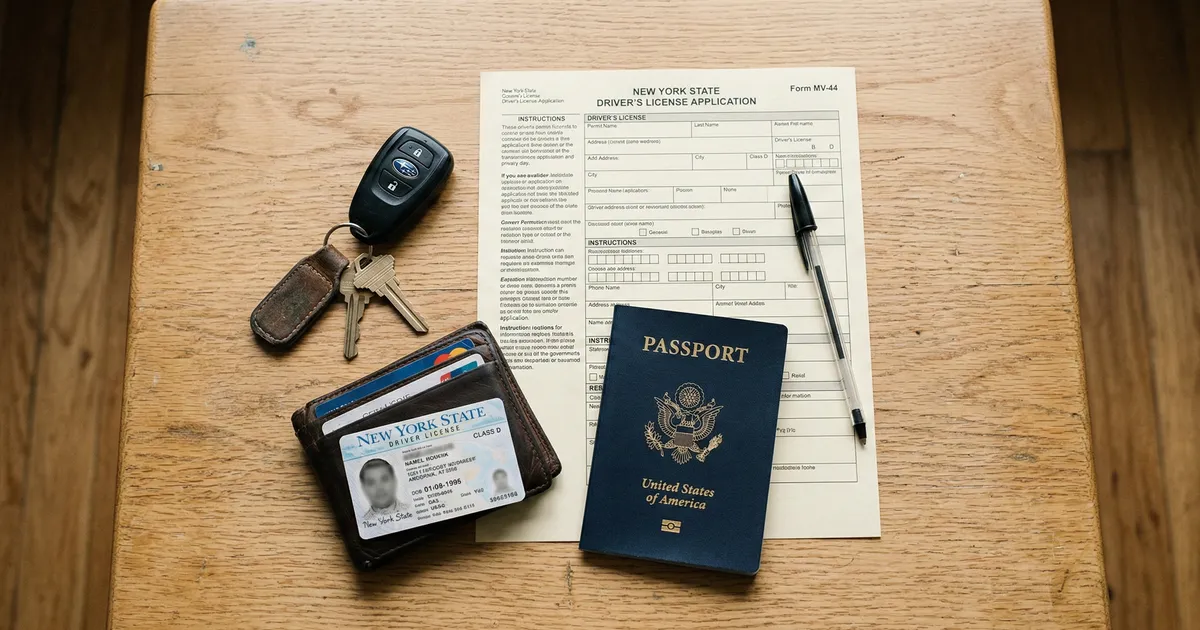
Getting turned away at the DMV because you forgot a document is one of the most frustrating experiences — and it's more common than you'd think. According to AAA, document issues are the #1 reason people leave the DMV without completing their transaction. Use the interactive checklist below to make sure you're fully prepared.
Interactive DMV checklist
Check off each item as you gather it. Items marked Required are needed by virtually every state. The rest depend on your situation — review the descriptions to see if they apply to you.
Identity & legal status
Proof of residency (typically 2 documents)
For REAL ID applicants
For applicants under 18
Payment & logistics
Extra documents (just in case)
Understanding the core documents
Proof of identity
Every state requires one primary document that proves who you are. The most commonly accepted are:
- U.S. birth certificate — must be an original or certified copy issued by a vital records office (hospital copies usually aren't accepted)
- Valid U.S. passport or passport card — the most convenient option since it proves both identity and citizenship in one document
- Permanent resident card (green card) — must be unexpired
- Certificate of naturalization (N-550 or N-570)
Not accepted in most states: school IDs, employee badges, expired documents, or photocopies.
Social Security number
Your SSN is verified electronically against Social Security Administration records, but you still need to present a document showing the number. Accepted documents typically include:
- Social Security card (even if laminated)
- W-2 or 1099 form showing full SSN
- SSA-1099 (Social Security benefit statement)
- Pay stub showing full SSN (some states)
Proof of residency
Most states require two separate documents showing your current address. These must be originals (not photocopies) and dated within the last 60–90 days. Common combinations:
- Utility bill + bank statement
- Lease agreement + voter registration card
- Mortgage statement + vehicle registration
- Government mail + property tax bill
Living with someone? If bills aren't in your name, some states allow a signed affidavit from the person you live with, plus their proof of residency. Check your state's specific policy.
REAL ID: what's different
As of May 7, 2025, a REAL ID-compliant license or ID is required to board domestic flights and enter federal facilities. If you're applying for a REAL ID (marked with a gold star), you'll need everything above plus:
- Proof of legal name changes: If your name differs from your birth certificate, bring every name change document in the chain (marriage certificates, divorce decrees, court orders)
- SSN document matching your current name: If you changed your name, update your Social Security card before your DMV visit
REAL ID requirements are set by the federal government via the Department of Homeland Security, but each state handles the application process differently.
Special situations
Under 18? Bring your parent.
In most states, a parent or legal guardian must either accompany you to the DMV and sign the application in person, or provide a notarized consent form. Many states also require:
- Proof of school enrollment or completion (report card, school ID, or transcript)
- Driver education completion certificate
- A log of supervised driving hours (check your state's GDL requirements)
Transferring from another state?
Bring your current valid out-of-state license. Some states also require a certified driving record from your previous state, which you may need to request in advance (processing can take 1–2 weeks).
Non-citizen applicants
In addition to standard documents, bring all immigration documents: valid visa, I-94 arrival record, EAD card, or other USCIS documentation. Your license expiration will typically be tied to your authorized stay period. Some states offer standard licenses to all residents regardless of immigration status.
Payment: what the DMV actually accepts
Fees range from $5 to $90+ depending on your state and license type. Accepted payment methods vary by state and sometimes by office location:
- Widely accepted: Cash, debit cards, money orders
- Sometimes accepted: Credit cards (often with a $1–3 processing fee)
- Rarely accepted: Personal checks, Apple Pay, or contactless payments
Bring at least two payment options. DMV office ATMs, when available, typically charge $3–5 in fees.
What NOT to bring (or expect)
- Study materials: Not allowed in the testing area. Do your studying before you arrive.
- Your own pencil: Tests are computer-based in most states. The few that still use paper provide pencils.
- Expired documents: Expired passports, expired green cards, and expired foreign IDs are generally not accepted.
- Photocopies: Original or certified copies only for identity documents. Some states allow photocopies for residency proof, but most don't.
Day-of tips
- Go early. Most DMV offices are least crowded in the first hour after opening, and on Tuesdays through Thursdays.
- Check wait times online. Many states publish real-time or estimated wait times on their DMV website.
- Double-check your documents the night before. Lay them all out and cross-reference the checklist above. It's much easier to solve a missing document problem at home than at the DMV counter.
- Bring a book or charger. Average DMV wait times range from 30 minutes to 2+ hours depending on location and time.
Once your documents are sorted, the only thing left is to study for the test itself. Try your state's free DMV practice test and aim for 90%+ before test day.