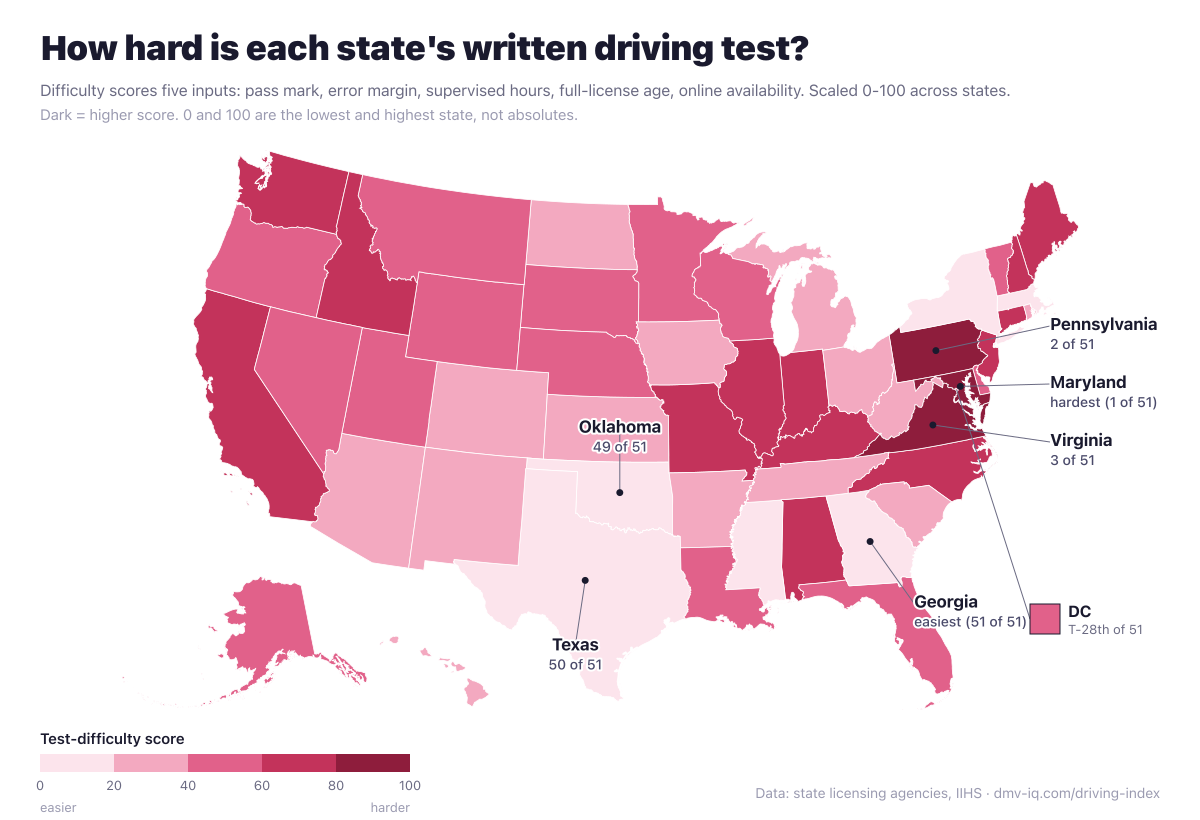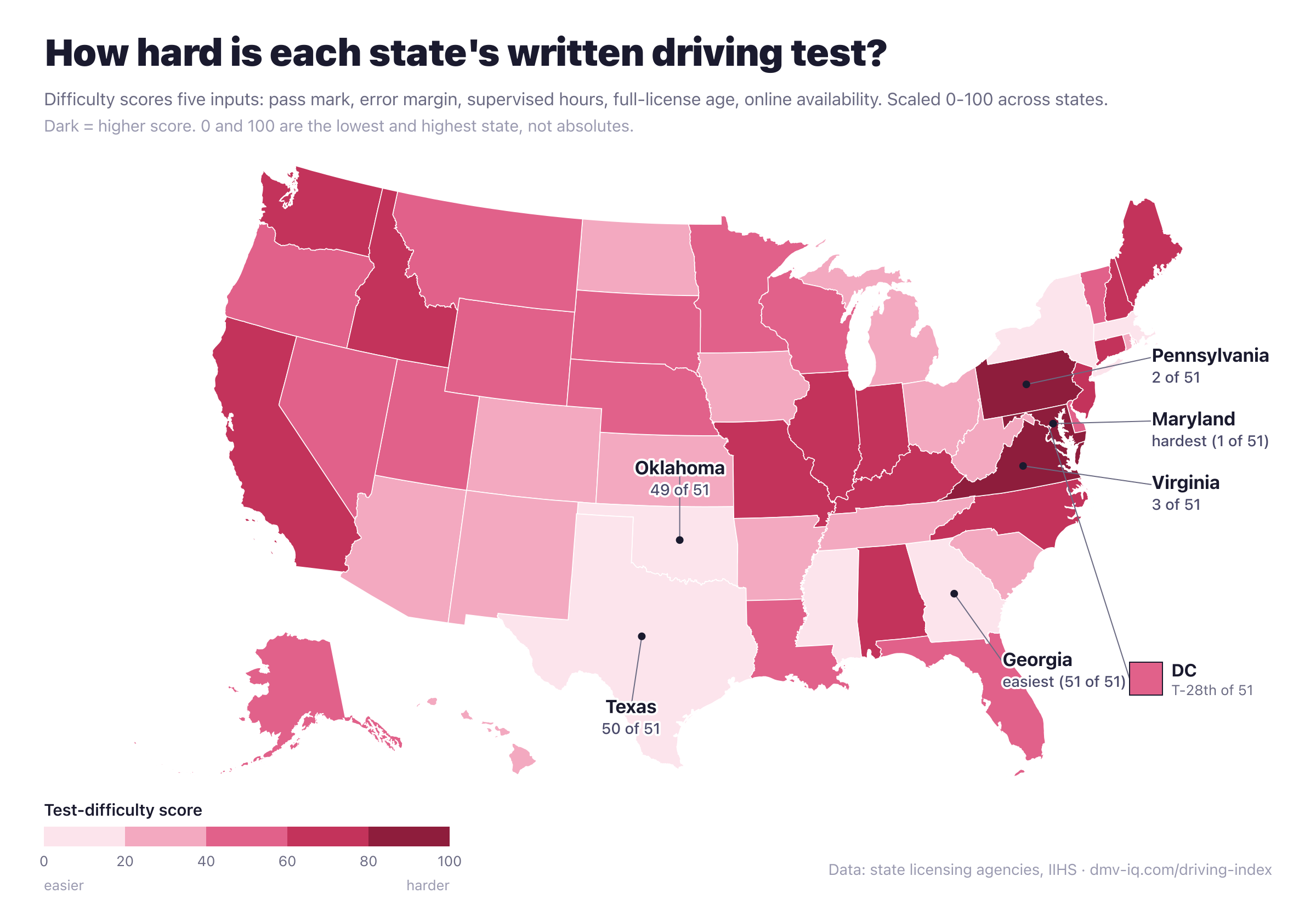
Not all driver-license tests are created equal. Some states ask more questions, set a higher passing score, demand more supervised practice hours, or hold full licensure back until age 18. We ranked every U.S. state plus DC on those five inputs in our American Driving Test Index - here's what shook out.
How the ranking works
Each state's test-difficulty score combines five inputs, weighted equally:
- Passing score percentage — the share of questions you need right
- Margin for error — how many wrong answers the test will accept, as a fraction of total questions
- Required supervised-driving hours — the IIHS-tracked behind-the-wheel hours before the road test
- Full-license age — the age at which all GDL restrictions lift
- Online-test availability — whether the knowledge test can be taken at home or only in person
Every input is z-scored across the 51 jurisdictions and rescaled 0-100. Knowledge-test specs come from each state DMV/DPS; supervised hours and full-license age from the IIHS state-laws tables.
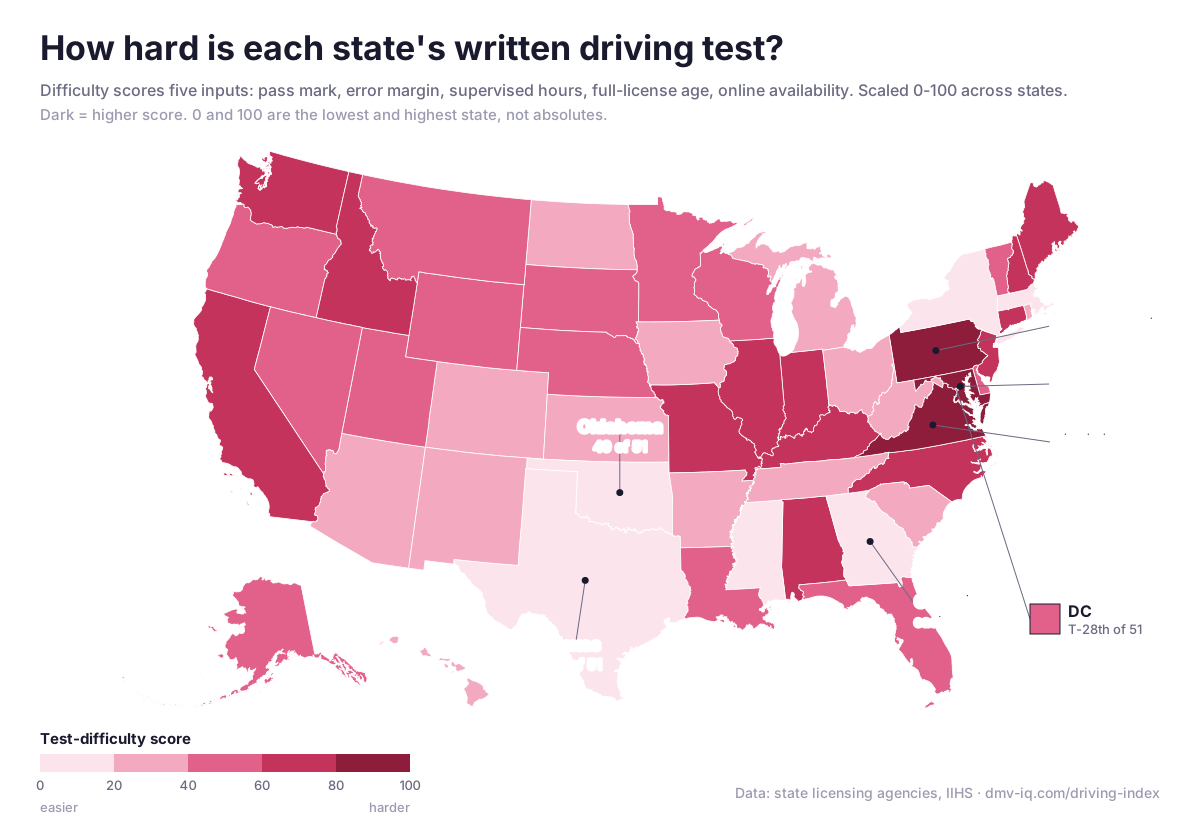
The map - every state on the index
Pick a state from the menu above or tap one on the map to see its details.
The hardest states
These are the jurisdictions ranked 10th-hardest or better. There are 11 of them, not ten: the composite produces genuine ties, and a rank shared by more than one jurisdiction is marked "T". Cutting the list at ten would mean dropping a state that earned its place.
| # | State | What stands out |
|---|---|---|
| 1 | Maryland | 88% to pass, 3 wrong allowed, 60 supervised hours, full license at 18, in person only. |
| 2 | Pennsylvania | 83% to pass, 3 wrong allowed, 65 supervised hours, full license at 18, in person only. |
| 3 | Virginia | 85% to pass, 6 wrong allowed, 45 supervised hours, full license at 18, in person only. |
| 4 | North Carolina | 80% to pass, 5 wrong allowed, 60 supervised hours, full license at 18, in person only. |
| 5 | Idaho | 85% to pass, 6 wrong allowed, 50 supervised hours, full license at 17, in person only. |
| 6 | Maine | 80% to pass, 6 wrong allowed, 70 supervised hours, full license at 17, in person only. |
| T-7 | Alabama | 80% to pass, 6 wrong allowed, 50 supervised hours, full license at 18, in person only. |
| T-7 | Illinois | 80% to pass, 7 wrong allowed, 50 supervised hours, full license at 18, in person only. |
| T-7 | Indiana | 80% to pass, 10 wrong allowed, 50 supervised hours, full license at 18, in person only. |
| T-7 | New Jersey | 80% to pass, 10 wrong allowed, 50 supervised hours, full license at 18, in person only. |
| T-7 | Washington | 80% to pass, 8 wrong allowed, 50 supervised hours, full license at 18, in person only. |
The margin trap: A 50-question test with 10 wrong answers allowed sounds generous — but it also means you study a much wider range of material. States with 20-25 questions draw from the same handbook, just test a random subset.
Hardest single inputs
Highest pass score: Maryland at 88%.
Most supervised hours: Maine at 70 hours.
Latest full license: 28 jurisdictions hold full licensure until age 18.
The easiest states by comparison
At the other end of the index, these 10 jurisdictions have the most lenient combinations of pass score, margin, supervised hours, licensing age, and online availability:
| # | State | What stands out |
|---|---|---|
| 42 | West Virginia | 76% to pass, 6 wrong allowed, 50 supervised hours, full license at 17, online test available. |
| 43 | Kansas | 80% to pass, 5 wrong allowed, 25 supervised hours, full license at 17, online test available. |
| 44 | Rhode Island | 70% to pass, 12 wrong allowed, 50 supervised hours, full license at 17, in person only. |
| 45 | Iowa | 80% to pass, 7 wrong allowed, 20 supervised hours, full license at 17, online test available. |
| 46 | Massachusetts | 72% to pass, 7 wrong allowed, 40 supervised hours, full license at 18, online test available. |
| 47 | New York | 70% to pass, 6 wrong allowed, 50 supervised hours, full license at 18, online test available. |
| 48 | Mississippi | 80% to pass, 6 wrong allowed, no required supervised hours, full license at 16, in person only. |
| 49 | Oklahoma | 75% to pass, 5 wrong allowed, 50 supervised hours, full license at 16, online test available. |
| 50 | Texas | 70% to pass, 9 wrong allowed, 30 supervised hours, full license at 18, online test available. |
| 51 | Georgia | 75% to pass, 25 wrong allowed, 40 supervised hours, full license at 18, in person only. |
The pattern at the easy end: lower pass thresholds, generous margins, online options, and earlier full-license ages. A test that meets you halfway on every input scores low on our composite even if it's not the very loosest on any single one.
One caveat on the numbers: each score is scaled 0 to 100 across the 51 jurisdictions, so a 0 marks the least demanding state on our five inputs, not a state with no test. Georgia sits at the bottom because its written test is the most forgiving to pass, not because it skips one.
Difficulty is only the written test
Everything above measures the knowledge test. The behind-the-wheel road test is a separate hurdle with its own rules, from whether parallel parking is scored to how long you wait to retake. See exactly what your state requires in our road test guides, or open any state's full profile, its knowledge-test specs plus road-safety and insurance-cost scores, on its Driving Index page.
The state you live in matters less than how much you've studied. Maryland's 88% pass score doesn't do anything to you if you walk in knowing the material. Find your state's DMV practice test, aim for 90%+ on three runs in a row, and the real thing tends to look familiar.
Data sources
Knowledge-test specs (questions, passing scores, online availability): each state's DMV / DPS / MVC website, compiled and date-stamped by DMV IQ.
GDL provisions, supervised hours, and full-license age: IIHS Graduated Licensing Laws Table.
Methodology and composite construction: see the index methodology section.