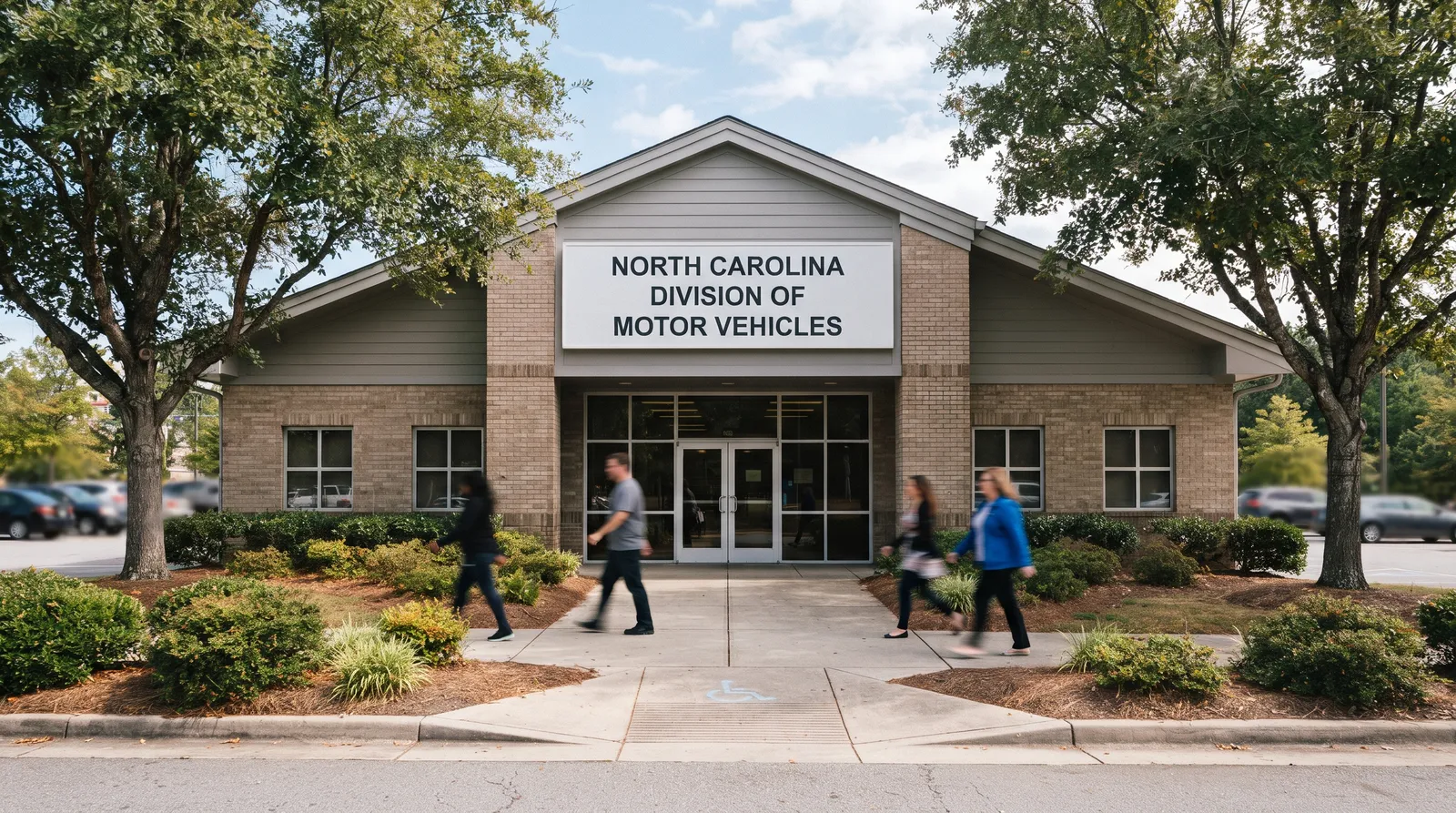
North Carolina DMV Numbers Cheat Sheet: Every Number You Need to Memorize
DMV IQ Editorial Team · Published November 7, 2026 · 4 min read
Checked against the handbook: 2025 edition. Values below come from the North Carolina Driver Handbook published by the North Carolina Division of Motor Vehicles, which we host as a free PDF on this site, except 2 rows marked as current law, where the printed handbook is out of date and we cite the statute or agency page instead. Nothing comes from a driving school, a forum or another prep site.
The North Carolina written test is full of numbers: how far, how fast, how old, how long, how much. This page puts 63 of them in one place, grouped into 14 sections. The biggest sections are distances, visibility and following (13), speed limits and road conditions (8), and graduated licensing (levels one to three) (6).
A few you will meet early:
Legal blood alcohol limit for drivers: 0.08% BAC
Proofs of North Carolina residency needed (adults 18 and over): REAL ID: 2 proofs of NC residency
Minimum age for a Level One Limited Learner Permit: 15 years
We started from our own North Carolina question bank, not from a generic list, so every row is a number our questions actually test. We then took the bank's answer out of the picture and read the figure in the handbook itself. If the handbook does not state a number, it is not on this sheet, even when a question tests it. In 4 places our question bank and the handbook differed. Those rows are flagged and show the handbook value.
North Carolina · Numbers reference
Every number the North Carolina written test can ask you for, in one place, taken from the official driver handbook and built to print.
63 numbersall tested in our question bank
Showing all 63 numbers
01
License classes and renewal
4 numbers
License classes and renewal, North Carolina
Value
Rule
Under 26,001 lb GVWR (towing a combination needs a driver 18 or older)
Weight limit of a regular Class C license (and towing age rule)Noncommercial vehicles
REAL ID: 2 proofs of NC residency
Proofs of North Carolina residency needed (adults 18 and over)Applicants 18 or over. The handbook says only 1 proof for a REAL ID; the agency now requires 2Our question bank and the state handbook disagree here. The handbook value is published.
8 years
How long a standard driver license lasts (issued at ages 18 to 65)Issued at age 18 to 65
5 years
How long a driver license lasts (issued at age 66 and older)Issued at age 66 or older
02
Graduated licensing (Levels One to Three)
6 numbers
Graduated licensing (Levels One to Three), North Carolina
Value
Rule
15 years
Minimum age for a Level One Limited Learner PermitMust also have completed an approved driver education course
9 months
How long you must hold the Level One permit before applying for a Limited Provisional License
60 hours (at least 10 at night)
Supervised driving hours to log on the permitLevel One permit Driving Log
5 years
How long a supervising driver must have been licensedApplies to Level One and Level Two supervising drivers
5 a.m. to 9 p.m.
Hours a Level Two license holder may drive without supervisionAlso any time when driving directly to or from work or volunteer fire, rescue or EMS duty
1 passenger under 21
Passengers under 21 allowed with a Level Two license holder driving unsupervisedNot a member of the driver’s household; household members are not limited; one more passenger under 21 is allowed if a student driven directly to or from school
03
Speed limits and road conditions
8 numbers
Speed limits and road conditions, North Carolina
Value
Rule
35 mph
Maximum speed limit in cities and towns (unless posted otherwise)Unless otherwise posted
55 mph
Maximum speed limit outside cities and towns
70 mph
Maximum speed limit on interstates
The first 10 to 15 minutes
How long roads stay extra slick after rain beginsEspecially if it has not rained for a while
At least 5 to 10 mph slower
How much slower to drive on wet pavementCompared with dry pavement
30 mph
Speed at which hydroplaning can beginIn water little more than 1/8 inch deep
6 inches sweeps a car off the road (12 inches can float it)
Depth of fast-moving water that can sweep a car awayFast-moving water across a roadway
By more than half
How much to reduce speed on packed snowSlow to a crawl on ice
04
Distances, visibility and following
13 numbers
Distances, visibility and following, North Carolina
Value
Rule
Between 15 and 50 feet
Distance from the nearest rail at which you must stop for a railroad signalWhen a signal, gate, flagger or approaching train requires a stop
At least 2 feet to the left
Minimum side clearance when passing another vehicle
At least 500 feet ahead
Sight distance needed on a curve or hill before passingPassing is unsafe where you cannot see this far
Up to 200 feet behind
How far behind a tractor-trailer its rear blind spot reachesFront no-zone is up to 20 feet
About a half mile
Clear roadway you may need to pass a vehicle towing a trailer
400 feet or less (and sunset to sunrise)
Visibility at which headlights are requiredAlso required whenever windshield wipers are in use
75 feet
Distance you should see a person with low-beam headlightsHigh beams: 200 feet
2 to 10 times farther than on dry pavement
How much longer stopping distances are on slippery pavementAllow at least twice the normal following distance
At least 3 times normal
Stopping distance to allow when starting or stopping on snow or ice
10 to 15 seconds ahead (about one city block)
How far ahead good drivers lookOur question bank and the state handbook disagree here. The handbook value is published.
About every 10 seconds
How often to check your mirrorsOur question bank and the state handbook disagree here. The handbook value is published.
At least every 2 hours
How often to stop and stretch on long drives
Preferably at least once every 100 miles
How often to stop at rest areas on an interstateInterstate driving
05
Where not to park
4 numbers
Where not to park, North Carolina
Value
Rule
15 feet
Minimum distance to park from a fire hydrant
15 feet
Minimum distance to park from a fire station entrance
25 feet (15 feet from right of way lines if no curb)
Minimum distance to park from the curb line of an intersecting street
400 feet (one block inside city limits)
Distance to keep from a fire or fire truck outside city limits
06
Signals, turns and roundabouts
3 numbers
Signals, turns and roundabouts, North Carolina
Value
Rule
At least the last 100 feet
How far before a turn or stop to signalSpeed limit under 45 mph
At least the last 200 feet
How far before a turn to signal on a faster roadSpeed limit 45 mph or more
Three-quarters of the way around
How far around a single-lane roundabout for a left turnExit to the right instead of a traditional left turn
07
Child restraints, seat belts and helmets
5 numbers
Child restraints, seat belts and helmets, North Carolina
Value
Rule
Under age 8 and under 80 pounds
Child restraint system required (age and weight)
Under age 5 and under 40 pounds
Child who must ride in the rear seat when there is an active front passenger air bagVehicle has a rear seat; not required if the child restraint is designed for use with a front air bag
Age 12 and under
Age up to which children should ride buckled in a rear seatHandbook safety point (should, not a legal minimum)
Under 16
Age under which children may not ride in an open pickup bedOpen bed or cargo area without permanent overhead restraining construction
Under 16
Age under which bicycle riders and passengers must wear a helmet
08
Vehicle and insurance
3 numbers
Vehicle and insurance, North Carolina
Value
Rule
1/16 inch
Minimum safe tire tread depthLess than this is unsafe
19 counties
Number of North Carolina counties that require emissions inspection
50,000 / 100,000 / 50,000
Minimum liability insurance (per person / all persons / property damage)Policies issued or renewed on or after July 1, 2025Our question bank and the state handbook disagree here. The handbook value is published.
09
Blood alcohol limits
3 numbers
Blood alcohol limits, North Carolina
Value
Rule
0.08% BAC
Legal blood alcohol limit for driversNoncommercial drivers
0.04% BAC
Legal blood alcohol limit when driving a commercial motor vehicleCommercial motor vehicle
0.00% BAC (any amount of alcohol)
Blood alcohol limit for drivers under 21Drivers under 21
10
Driver license points by offense
3 numbers
Driver license points by offense, North Carolina
Value
Rule
5 points
Driver license points for passing a stopped school busNon-commercial driving
3 points
Driver license points for running through a red lightNon-commercial driving
1 point
Driver license points for littering from a motor vehicle
11
Point thresholds
2 numbers
Point thresholds, North Carolina
Value
Rule
12 points in 3 years
Driver license points within three years that can lead to suspension
3 points
Points removed for completing a driver improvement clinicClinic is offered at 7 points
12
Suspensions and revocations
6 numbers
Suspensions and revocations, North Carolina
Value
Rule
At least 30 days, plus a minimum 12-month revocation
Revocation for refusing a chemical testBreath or blood test after a DWI charge
Minimum 30 days
Immediate revocation when a test shows 0.08 or more0.04 for commercial vehicles
1 year
License revocation after a first DWI conviction
4 years
License revocation after a second DWI convictionPrior offense within three years
1 year
Suspension for two reckless driving chargesTwo charges within 12 months
60 days
Length of the first suspension under the point systemSecond is 6 months, third is 12 months
13
Fines and penalties
2 numbers
Fines and penalties, North Carolina
Value
Rule
$100 to $500
Penalty for failing to yield to a pedestrian when turning right on red
$25
Fine for a child riding in an open pickup bedInfraction: no points, no court costs
14
Reporting a crash
1 number
Reporting a crash, North Carolina
Value
Rule
$1,000 or more (or any injury or death)
Property damage that requires a crash report to law enforcement
Print it (the button above gives a clean one or two page version) or filter it on screen. Do not try to memorize the whole list in one go. Pick one section, say it out loud, then answer practice questions on that topic until the numbers stick.
What this sheet leaves out
The handbook is a summary of the law, not the law itself. Fines, court costs and fees change, and some are set by statute rather than printed in the handbook. We only list what the handbook (or, where marked, the statute) states, so check the North Carolina Division of Motor Vehicles for anything that decides a real case. The handbook edition used here is 2025; the numbers were last checked against it on November 7, 2026.