Picture a driver who has held a clean license for 20 years. She moves from Oregon to Sacramento in August, unpacks, and assumes the DMV visit is paperwork. Under the California DMV's own rules, it isn't. She has 10 days from becoming a resident, and the visit ends with a knowledge test she gets three tries to pass. Fail it three times and the application is void.
Move the same driver to Austin, Tampa or Buffalo and she likely never sees a test question. Here is how the four most-searched destination states handle it, taken from their official pages.
The four big states, side by side
| California | Texas | Florida | New York | |
|---|---|---|---|---|
| Deadline | 10 days after residency | May drive on old license up to 90 days | 30 days after residency | 30 days after residency |
| Written test? | Yes | No (adults with a valid U.S., territory or Canadian license) | Generally no | No, if the license qualifies |
| Vision test? | Yes | Yes, at the license office | Yes | Yes |
| Road test? | Only if the DMV requires one | No for 18+; under 18 must test | Generally no | No, if it qualifies |
| Fee | $46 (Class C original) | $33 (age 18 to 84, new) | $48 + up to $6.25 office fee | Varies; see NY DMV |
| Official page | CA DMV | Texas DPS | FLHSMV | NY DMV |
Read the deadline row carefully. California and Florida count from the day you become a resident. Texas phrases it as how long you may keep driving on the old card.
California: the one that makes you test
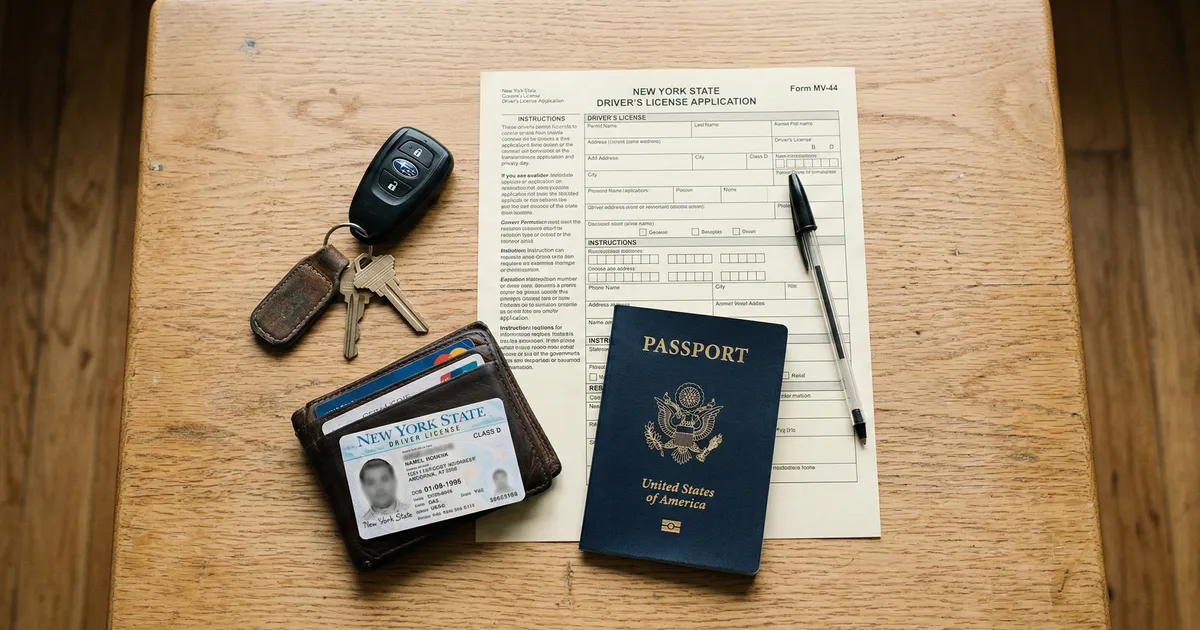
The DMV's page lays it out under "Situation #2: I have a DL issued by another state." You complete a DL/ID application, give your Social Security number, prove identity, show residency documents if you've never held a California card, pay the nonrefundable fee, get a thumbprint and photo, pass a vision exam and pass the knowledge test. The DMV's licensing-fees page lists the Class C original application at $46, and the application is good for 12 months.
What catches people is the attempt limit. You get three tries at each required knowledge test. The DMV also won't start a knowledge test within 30 minutes of closing, so a 4:45 p.m. walk-in at a 5 p.m. office is wasted.
Residency comes sooner than many expect. The New to California guide says you're a resident if you intend to live in the state six months or more in a year, and it lists signs such as registering to vote or enrolling children in school.
A worked example: you sign a lease and start a job in San Diego on March 1. Treat March 1 as day one and plan to finish the knowledge test by March 11. Study first. A license from another state means you learned that state's handbook, not the California numbers that show up on the test. One run through a free California practice test will show you what you've forgotten.
If you want a REAL ID-compliant card, the DMV's fast-facts sheet asks for two proofs of residency, so bring both on the first trip. The rest is in our REAL ID guide.
Texas: hand over the old card
Texas DPS says new residents may drive on a valid out-of-state license for up to 90 days. If you're 18 or older and surrender a valid license from another U.S. state, territory or Canadian province, you skip the knowledge and skills exams. That holds even if the license expired less than two years ago. DPS lists the fee for a new license at age 18 to 84 at $33, which includes a $1 administrative fee.
Two rules trip people up. First, DPS says your vehicles must be registered in Texas before you apply for the license, so the county tax office comes first. Second, applicants under 18 must take the driving test even with an out-of-state license. If you want a refresher anyway, we keep the Texas rules and figures in one place.
Florida: 30 days, a vision test and a fast car deadline
FLHSMV gives new residents 30 days to get a Florida license, and you must pass a vision test. Drivers with a valid out-of-state license may get a Florida license without the written or road test. You apply in person.
The vehicle clock is tighter. Florida says you must buy insurance from a Florida-licensed agent and title and register your vehicles within 10 days of establishing residency. The state counts you as a resident when, for example, you start a job, enroll children in public school, register to vote or have lived there more than six consecutive months.
On cost, FLHSMV lists an initial Class E license at $48 and notes most tax collector offices add a $6.25 service fee. Budget $54.25.
New York: an exchange with four conditions
New York calls it an exchange, and you have 30 days after becoming a resident. Living in the state 90 days is "presumptive evidence" of residency. To skip testing, your license must be:
- show your photograph;
- valid, or expired less than 24 months;
- issued at least six months before you apply; and
- from another U.S. state, a territory or a qualifying jurisdiction.
You pass a vision test, surrender the old license, pay the fee and apply in person. The DMV hands you a temporary document and says the card typically arrives in about two weeks. If your license is less than six months old, you're on a different track, so read the exchange page before booking.
Mistakes we see new residents make
- Counting from moving day instead of residency day. A job start or school enrollment can make you a Florida resident before the truck is unloaded.
- Leaving the old card at home. Texas and New York say you surrender it. Bring the physical card.
- Mismatched names. California says your current name must match your identity document. If you married or divorced, bring the linking documents. Our document checklist for your DMV visit lists them.
- Assuming an expired license still transfers. Texas allows under two years; New York under 24 months. Past that, expect to test like a new driver.
- Walking into California's test cold. Three failures void the application. If it goes badly, read what happens after a failed attempt before you rebook.
If your new state does test you
The written test isn't hard because driving is different across a state line. It's hard because every state asks about its own numbers: blood-alcohol limits for young drivers, following distances, distance from a hydrant. Here's how we'd prepare in one week:
- Download the current handbook. Don't trust a summary from years ago.
- Check question counts and passing scores by state so you know the passing line.
- Take one timed practice test cold. Score yourself.
- Study only the sections you missed, then retest two days later.
- Book the appointment once you pass practice tests comfortably.
What to do next
- Mark your deadline: 10 days (CA), 30 days (FL, NY) or 90 days of driving (TX).
- Moving to California? Take a timed practice test today, then see how California compares on cost and difficulty.
- Gather identity, Social Security and two proofs of address if you want REAL ID.
Frequently asked questions
Do I have to take a written test when I move to a new state?
It depends on the state. California requires new residents with an out-of-state license to pass a knowledge test and a vision exam. Texas, Florida and New York generally let adults with a valid U.S. license transfer it without a written test, with conditions.
How long do I have to get a new driver's license after moving?
California gives 10 days, Florida and New York 30 days. Texas lets new residents drive on a valid out-of-state license for up to 90 days. The clock usually starts when you establish residency.
When am I considered a resident of my new state?
California says you're a resident if you intend to live there six months or more in a year. Florida lists triggers such as starting a job, enrolling children in public school or registering to vote. New York treats 90 days of living there as presumptive evidence.
Does California make out-of-state drivers take a road test?
The DMV's steps for someone with another state's license list a knowledge test and a vision exam, not a drive test. A drive test applies to applicants with a license from another country.
What if my out-of-state license has expired?
Texas lets adults transfer a license that expired less than two years ago without exams. New York accepts one expired less than 24 months. Beyond that, expect to be treated as a new applicant.
How we checked this
We read each state's official new-resident and fee pages on November 15, 2026, and used only what they say. Fees change; confirm on the official page before you go.
- California DMV, Driver's Licenses (Situation #2): https://www.dmv.ca.gov/portal/driver-licenses-identification-cards/driver-licenses-dl/
- California DMV, Licensing Fees: https://www.dmv.ca.gov/portal/driver-licenses-identification-cards/licensing-fees/
- California DMV, Fast Facts FFDL 5 (Requirements for a California Driver's License): https://www.dmv.ca.gov/portal/file/fast-facts-5-requirements-for-a-california-drivers-license/
- California DMV, New to California: https://www.dmv.ca.gov/portal/driver-education-and-safety/special-interest-driver-guides/new-to-california/
- Texas DPS, Moving to Texas: https://www.dps.texas.gov/section/driver-license/moving-texas-guide-driver-licenses-and-ids
- Texas DPS, Driver License Fees: https://www.dps.texas.gov/section/driver-license/driver-license-fees
- Florida HSMV, New Residents: https://www.flhsmv.gov/new-resident/
- New York DMV, Exchange an out-of-state driver license: https://dmv.ny.gov/driver-license/exchange-out-of-state-driver-license